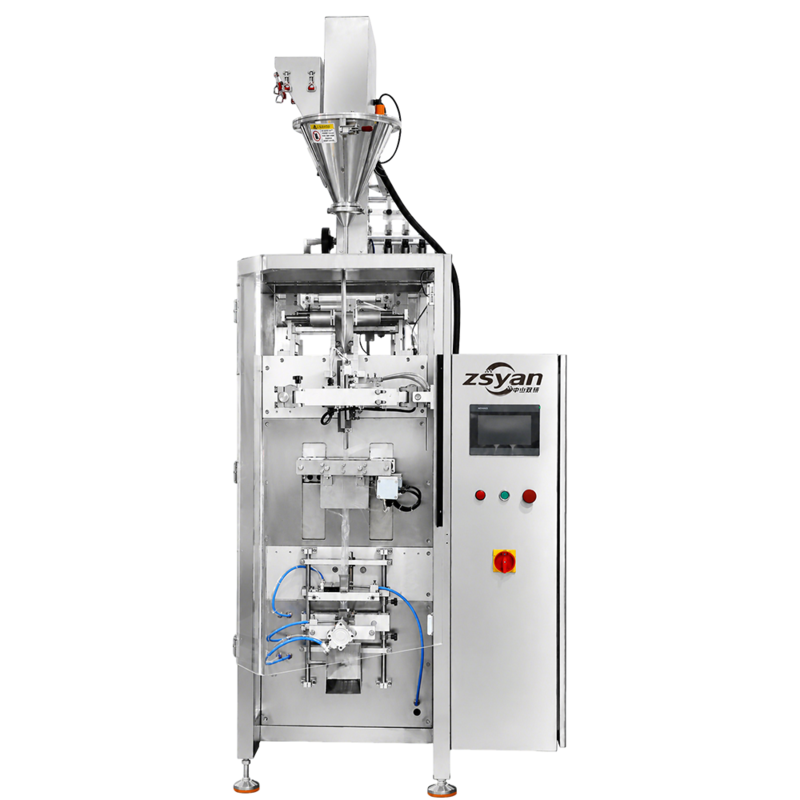
ZSYAN SY-P1L200 Vertical Form Fill Seal Powder Packing System
1. Quick Answer & Overview
Overview & Quick Answer: The ZSYAN SY-P1L200 single-lane powder packaging machine is an automated vertical form-fill-seal system designed for precise, dust-free pouch packaging of fine powders including spices, coffee, starch, and flour. Operating at 25 to 50 bags per minute across a 5g to 200g dosing range, the machine integrates a vertical servo auger screw, an agitated product hopper, an active dust suction hood, and continuous heat-sealing jaws. Built in electropolished AISI 304 stainless steel with Omron PLC control and digital temperature modules, the closed auger mechanism prevents airborne product dusting while holding dosing accuracy within ±0.5 percent. Consuming 2.2 kW under 0.6 MPa air pressure, it prevents product giveaway and eliminates two manual packaging workers, delivering full capital expenditure payback within 2.4 to 3.6 operational months in commercial processing environments.
2. System Architecture & Workflow
The engineering flow diagram below maps the continuous sequence of automated operations—from infeed metering to final hermetic discharge:
[Sealed Stainless Bulk Powder Infeed Hopper (30L)]
                       │
                       ▼
[Slow-Speed Anti-Bridging Agitator & Level Sensor]
                       │
                       ▼
[Micro-Step Servo-Driven Precision Vertical Auger Screw]
                       │
                       ▼
[Vertical Forming Tube with Integrated Exhaust Dust Shroud]
                       │
                       ▼
[Negative-Pressure Dust Extraction Port to Central Vacuum]
                       │
                       ▼
[Pneumatic Clamping Dosing Discharge Gate (Zero Dust Leak)]
                       │
                       ▼
[Pneumatic Horizontal Heat Seal & Serrated Tear Cutoff]
                       │
                       ▼
[Finished Powder Pouch Output on Incline Flight Conveyor]
Micro-fine powders such as milk powder and ground spices create floating airborne dust that contaminates film heat seals, causing leaks and factory air quality hazards. The SY-P1L200 resolves this with a dual-stage containment architecture: a high-precision servo motor drives an enclosed vertical dosing auger, while an inline negative-pressure vacuum collar draws away stray aerosolized particles before the transverse heat-sealing jaws close.
---
3. Technical Specifications Matrix
Direct horizontal engineering benchmark comparing ZSYAN equipment against conventional machinery and manual packaging:
| Performance Parameters | ZSYAN SY-P1L200 (Servo Auger) | Conventional Cup/Volumetric Bagger | Manual Electronic Scale Bench |
|---|
| Dosing Technology | Precision vertical servo auger screw | Rotating volumetric cup disc | Manual scoop + static bench scale |
| Packaging Rate | 25 – 50 bags/min (continuous servo) | 20 – 35 bags/min (frequent dusting) | 5 – 8 bags/min per operator |
| Dosing Range | 5g – 200g (interchangeable screws) | 10g – 100g | 10g – 500g |
| Dosing Tolerance | ±0.5% – ±1.0% (closed-loop servo) | ±2.5% – ±4.0% (density sensitive) | ±2.0% – ±5.0% |
| Dust Containment | Sealed negative-pressure suction hood | Open gravity fall (severe dusting) | Open air (operator exposure) |
| Air Consumption | 0.6 MPa, 0.30 m³/min | 0.6 MPa, 0.25 m³/min | N/A |
| Power Consumption | 2.2 kW, 1-Phase 220V 50/60Hz | 2.0 kW, 1-Phase 220V | 0.2 kW |
| Machine Dimensions | 1,450 × 1,150 × 2,100 mm | 1,350 × 1,050 × 1,900 mm | 1,200 × 800 mm (table) |
| FOB Investment Range | USD $8,500 – $12,800 | USD $6,000 – $8,500 | USD $1,500 |
4. Mathematical ROI & Payback
Financial payback model quantifying direct labor reduction, material optimization, and overfill elimination:
Direct Annual Net Savings (S) = [Powder Giveaway Elimination] + [Labor Reduction] + [Seal Defect Waste Saved]

Where:
- Giveaway Elimination: 2.2g overfill saved per bag on 2.2M bags/yr ($0.004/g specialty spice) = $19,360
- Labor Reduction: 2 manual weighing/sealing operators replaced × $13,500 annual cost = $27,000
- Seal Defect Elimination: Rejection rate reduced from 3.8% to 0.2% via dust suction = $4,500
Total Annual Net Economic Benefit (S) = $50,860 USD
Machine Purchase Capital Expenditure (Capex) = $11,500 USD

Payback Horizon = (Capex / S) × 12 Months
                = ($11,500 / $50,860) × 12 = 2.71 Months
By eliminating product overfill on expensive powdered raw ingredients and removing tedious manual weighing labor, spice and food processors recover total capital outlay in approximately 2.7 operational months.
---
5. Engineering FAQs
Practical technical answers addressed to plant managers, automation engineers, and procurement directors (Click to expand technical response):
The auger screw is coupled directly to a high-resolution Delta AC servo motor capable of dividing each rotation into 10,000 discrete pulses. In addition, an independent low-speed horizontal scraper arm rotates within the conical hopper, gently degassing the powder column and maintaining constant bulk density above the auger flighting for repeatable volumetric discharge.
The filling tube is constructed with concentric twin walls. The inner channel conveys the powder column, while the outer annular jacket is plumbed to a plant vacuum extractor. As powder drops into the pouch, the counter-current exhaust airflow captures all airborne micro-particles, keeping film heat-seal interfaces pristine and guaranteeing zero seal pinholes.
The auger tooling uses a quick-release spline collar. To change package weight ranges, the operator loosens two stainless thumb screws on the hopper lid, disconnects the auger shaft clamp, and slips in a larger diameter flighting screw and matching discharge funnel in less than 8 minutes without hand wrenches.
Yes. For cohesive, fat-rich powders, the hopper is fitted with a specialized Teflon-coated flighting screw and an electromagnetic vibratory collar on the forming funnel. This ensures that oily particles do not adhere to metal walls or form hanging bridges, discharging smoothly with each servo cycle.
The 30-liter hopper splits vertically on a hinged clamshell design secured with sanitary triclamp fasteners. Operators can swing the hopper open completely in 30 seconds to wipe down the polished stainless steel interior, auger screw, and agitator blades with food-safe sanitizing sprays without dismantling electrical wiring.
6. Technical Inquiries & Quotes
Ready to Automate Your Packaging Facility?
Consult directly with ZSYAN factory engineers for custom pouch specifications, line layouts, and direct FOB quotations within 24 hours.


