
Daily Capacity Over 10,000 Bags — Should You Choose Single-Lane, Double-Lane, or Multi-Lane? This Article Explains It All
Daily Capacity Over 10,000 Bags — Should You Choose Single-Lane, Double-Lane, or Multi-Lane? This Article Explains It All
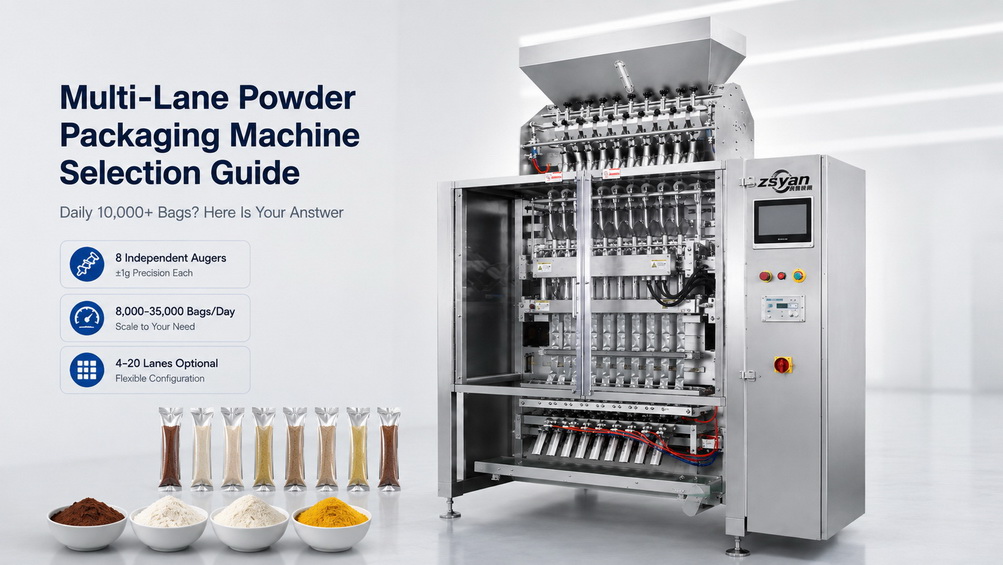
Do You Also Face This Problem?
Factory orders keep growing. Your current packaging machine runs 24 hours a day and still can't catch up with shipping speed. You start considering an upgrade, but when you open a website, you see:
Single-lane machine: Cheap, but not enough capacity
Double-lane machine: Capacity doubles, but still tight during peak season
Multi-lane machine: Capacity multiplies several times, but how much more does it cost? Is it worth it?
Choose wrong, and you'll either continue struggling with capacity bottlenecks or waste your investment.
Today, we'll help you clarify your thinking through three dimensions.
The First Calculation: Calculate Capacity, Don't Go by Feel
Many factory owners, when upgrading equipment, only look at "how many bags we produce per day now." This is the biggest misconception.
The correct approach is: Calculate your capacity demand for the next 6-12 months.
| Your Current Situation | Recommended Model | Reasoning |
|---|---|---|
| Daily output < 5,000 bags | Single-Lane SY-L180 | Low investment, sufficient |
| Daily output 5,000-10,000 bags | Double-Lane SY-DL200 | Balanced capacity and precision |
| Daily output 10,000-20,000 bags | Multi-Lane SY-ML800 (8-lane) | Best cost-effectiveness |
| Daily output > 20,000 bags | Multi-Lane SY-ML1200 (12+ lanes) | Large capacity first choice |
Remember: The machine's capacity should be 1.5x your current demand. Leave room for growth, avoiding another upgrade in half a year.
The Second Calculation: Calculate Precision, Don't Just Look at Speed
Some customers ask "how fast is it" first, but ignore precision.
In powder packaging, precision is profit. Give 1g extra per bag, and you lose tons per year. Give 1g short per bag, and customer complaints destroy your brand.
| Model | Metering Method | Precision | Suitable Materials |
|---|---|---|---|
| SY-L180 Single-Lane | Auger metering | ±1g | Coffee powder, milk powder, protein powder |
| SY-DL200 Double-Lane | Dual auger parallel | ±1g | Seasonings, flour, additives |
| SY-ML800 Multi-Lane | Multi-auger independent metering | ±1g | High-speed large-batch powder |
Key insight: Multi-lane precision isn't traded for speed — it's achieved through independent augers plus servo control. Each column is an independent metering system, not interfering with each other.
The Third Calculation: Calculate ROI, Don't Just Look at Equipment Price
Equipment purchase price is just the first hurdle. What truly determines value is Total Cost of Ownership (TCO).
Taking a daily output of 15,000 bags as an example, comparing different configurations:
| Configuration | Equipment Investment | Annual Labor Cost | Annual Maintenance | Total Annual Cost |
|---|---|---|---|---|
| 3× Single-Lane Machines | $24,000 | $14,400 | $3,000 | $41,400 |
| 2× Double-Lane Machines | $30,000 | $7,200 | $4,000 | $41,200 |
| 1× Multi-Lane Machine | $28,000 | $4,800 | $3,500 | $36,300 |
A single multi-lane machine has the lowest annual operating cost and the shortest payback period. Plus, it occupies less floor space, saving on factory rent.
Three-Dimension Selection Checklist
Before you contact suppliers, confirm these three things:
✅ Material Properties
Particle size range: Ultra-fine (<50μm) / Fine (50-200μm) / Medium-coarse (>200μm)
Flowability: Free-flowing / Prone to caking / Prone to dust
Corrosiveness: Food-grade / Lightly corrosive / Strongly corrosive
✅ Capacity Demand
Current daily output: ___ bags
Estimated demand in next 12 months: ___ bags
Peak period demand: ___ bags (used to calculate machine specification)
✅ Packaging Format
Bag type: Back seal / Three-side seal / Four-side seal
Weight range: ___g - ___g
Film type: Aluminum foil composite / PE composite / Other
Common Misconceptions
Misconception 1: Multi-lane machines are always more than double the price of single-lane → Reality: Multi-lane machine's cost-per-unit-capacity is lower. One 8-lane machine ≈ 4-5 single-lane machines' capacity, but costs only 1.5-2x the price.
Misconception 2: Multi-lane machines can't match single-lane precision → Reality: Independent auger metering + servo control means each column's precision matches single-lane (±1g).
Misconception 3: Switching specifications is very troublesome → Reality: 7-inch touchscreen + 99-group program storage, switching specs只需调参数, completed in 15-25 minutes.
Action Checklist
If you're still hesitating after reading this article, follow these steps:
Organize your material list: What powder products? How much daily demand per product?
Calculate capacity gap: Current machine maximum capacity vs. actual demand
Contact suppliers: Provide material samples, request trial run
Request TCO analysis: Ask suppliers for a 3-year total cost comparison
Confirm after-sales support: Remote guidance, spare parts supply, warranty terms
Choosing the right packaging machine isn't about picking the most expensive one — it's about picking the one that fits your capacity demand. Not sure which to choose? Click here for a free capacity assessment.


