
A Sauce Factory Cut Packaging Costs by 40% Without Touching Its Old Machines — Here Is How They Did It
A Sauce Factory Cut Packaging Costs by 40% Without Touching Its Old Machines — Here Is How They Did It
I. The Problem That Wasn't About Speed
Rajkot, Gujarat — Vikram Patel runs a small but steady sauce manufacturing business. His products — chili paste, garlic sauce, and tamarind concentrate — go mainly to Indian restaurants and ethnic grocery stores across the Gulf region.
For five years, his operation ran on two single-lane liquid packaging machines and three operators. It worked. Not great, not terrible. He could fill about 2,200 bags a day. Enough to keep the lights on. Enough to say no to a few orders he couldn't handle.
Then a distributor in Dubai placed an order for 50,000 bags — a single order larger than what his factory produced in three weeks.
"We said yes because we couldn't afford to say no," Patel said. "Then we spent the next six weeks trying to figure out how."
He didn't buy a new machine. He didn't hire more people. What he did was something most factory owners skip: he figured out exactly where the money was leaking — and fixed the leak instead of chasing speed.
II. Where the Money Was Going
Patel pulled his packaging logs from the past year and traced every bag that left the factory. Three problems jumped out:
1. Overfill. To guard against underfill complaints, his operators had been adding roughly 4% extra product to every bag. With liquid seasonings at $2.80 per kilogram, that 4% added up to about $8,500 in wasted product per month.
2. Changeover waste. Switching from chili paste to garlic sauce meant running the machine dry, washing nozzles, and testing three bags before production restarted. Each changeover lost about 120 bags worth of product — roughly $340. He did this six times a week.
3. Rework. Bags with poor seals or incorrect weights had to be reworked or discarded. On average, 6% of daily output fell into this category. For a factory producing 2,200 bags a day, that's 132 bags thrown away — about $1,100 per month.
Total waste: roughly $12,940 per month. Or about $155,000 per year.
"This wasn't a speed problem," Patel said. "It was a precision problem. We were losing money on every single bag we made."
III. The Decision: Upgrade the Metering, Not the Whole Line
Patel's instinct was to buy a bigger machine — maybe a multi-lane model — and push harder. But his accountant pointed out that a new machine wouldn't fix the waste; it would just waste more product faster.
Instead, they looked at what would actually move the needle.
ZSYAN's technical team recommended a configuration change rather than a full replacement:
Install a piston-type metering system on the existing back-seal machine (replacing the older cup metering that couldn't handle their thick chili paste consistently)
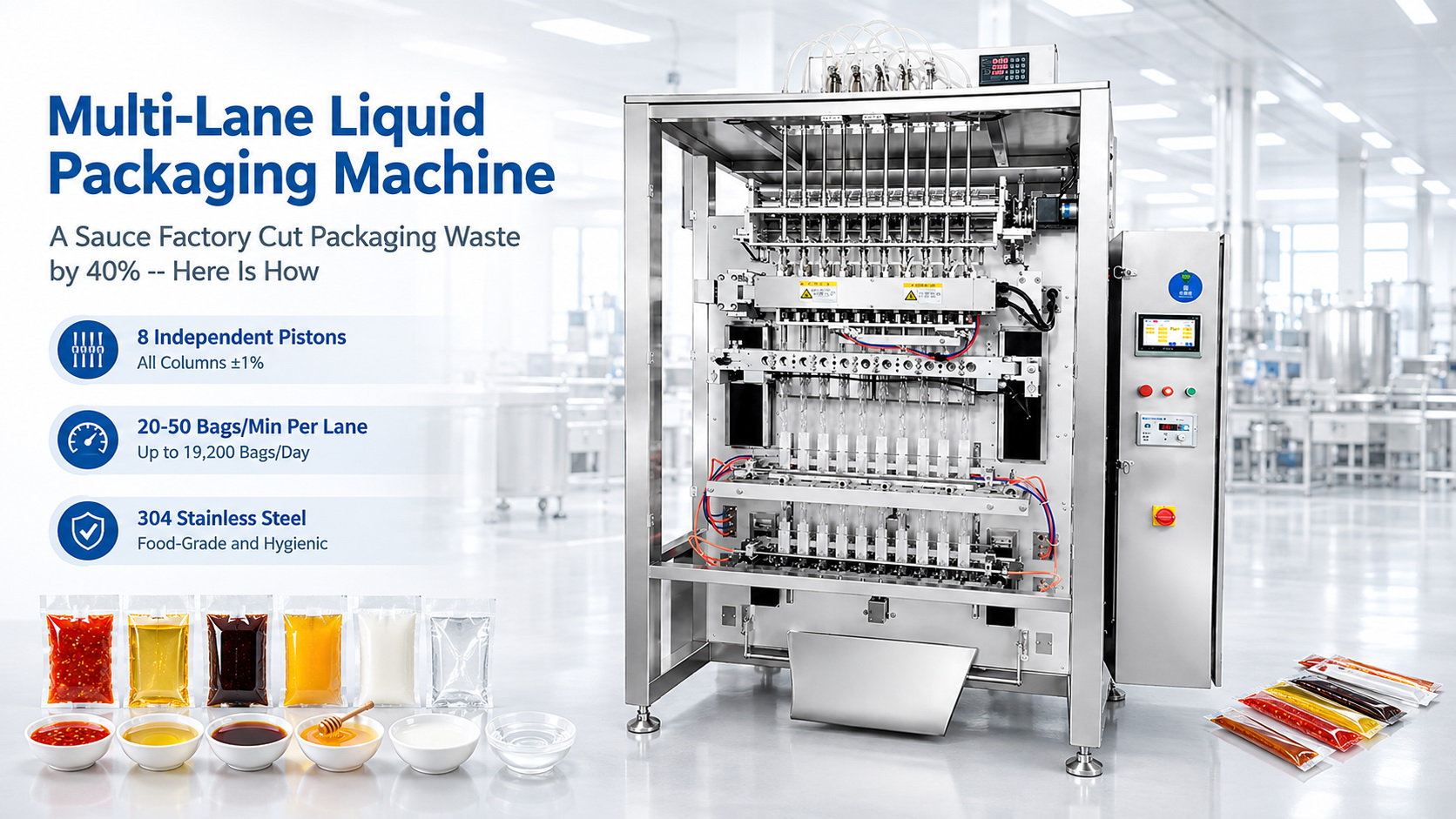
Add a second SY-LNL600 eight-lane machine for the high-volume garlic sauce line
Keep the original machines running for lower-volume specialty products
The investment: $38,000 for the new eight-lane unit plus retrofit parts for the existing machine. Not a complete line overhaul — a targeted upgrade.
IV. What Changed After Installation
The new eight-lane machine arrived in early March. Installation and commissioning took two days. By the fourth day, Patel was watching data that surprised him:
| Metric | Before | After | Change |
|---|---|---|---|
| Weight accuracy | ±4% | ±1% | 4x improvement |
| Overfill rate | ~4% of product | ~0.5% | Saved ~$7,200/month |
| Changeover time | 45 min | 8 min | Saved ~$200/change |
| Rework rate | 6% of output | 1.2% | Saved ~$880/month |
| Daily output | 2,200 bags | 4,800 bags | +118% |
| Operators needed | 3 people | 2 people | Saved 1 headcount |
| Monthly waste cost | ~$12,940 | ~$2,100 | -84% |
The numbers Patel cared about most: waste dropped from $12,940 to $2,100 per month. That's $130,000 a year saved — without buying a bigger facility, without hiring more people, and without changing their product mix.
"I kept telling myself we needed more speed," Patel said. "What we actually needed was less waste. Those are very different problems."
V. The Dubai Order — Fulfilled on Time
Six months later, the same Dubai distributor came back with another large order — this time 80,000 bags. Patel accepted it without hesitation.
The eight-lane machine ran for 18 days straight to fulfill it. No overtime. No temporary workers. No second-guessing.
"The first time, we were scrambling," he said. "This time, we barely noticed it was happening."
VI. Three Things Patel Would Tell His Past Self
"Measure your waste before you measure your speed." Most factory owners start by asking how many bags per minute they need. Patel wishes he'd started by asking how much product they were throwing away each month. The answer to that question determines whether a new machine is actually the right solution.
"Precision pays faster than speed." An eight-lane machine at ±1% precision costs less in wasted product per year than a faster machine at ±3% precision. The math works out clearly once you track your actual waste, not just your output rate.
"Don't replace what works — upgrade what leaks." Patel's original machines still run today, handling specialty products at lower volumes. He didn't scrap them. He added the eight-lane machine for the high-volume lines where precision mattered most, and let the old equipment do what it was good at.


