
Why More Lanes Does Not Always Mean More Output - The Hidden Math Behind Multi-Lane Liquid Packaging
Why More Lanes Does Not Always Mean More Output - The Hidden Math Behind Multi-Lane Liquid Packaging
I. What You Think You Know vs. What's Actually Happening
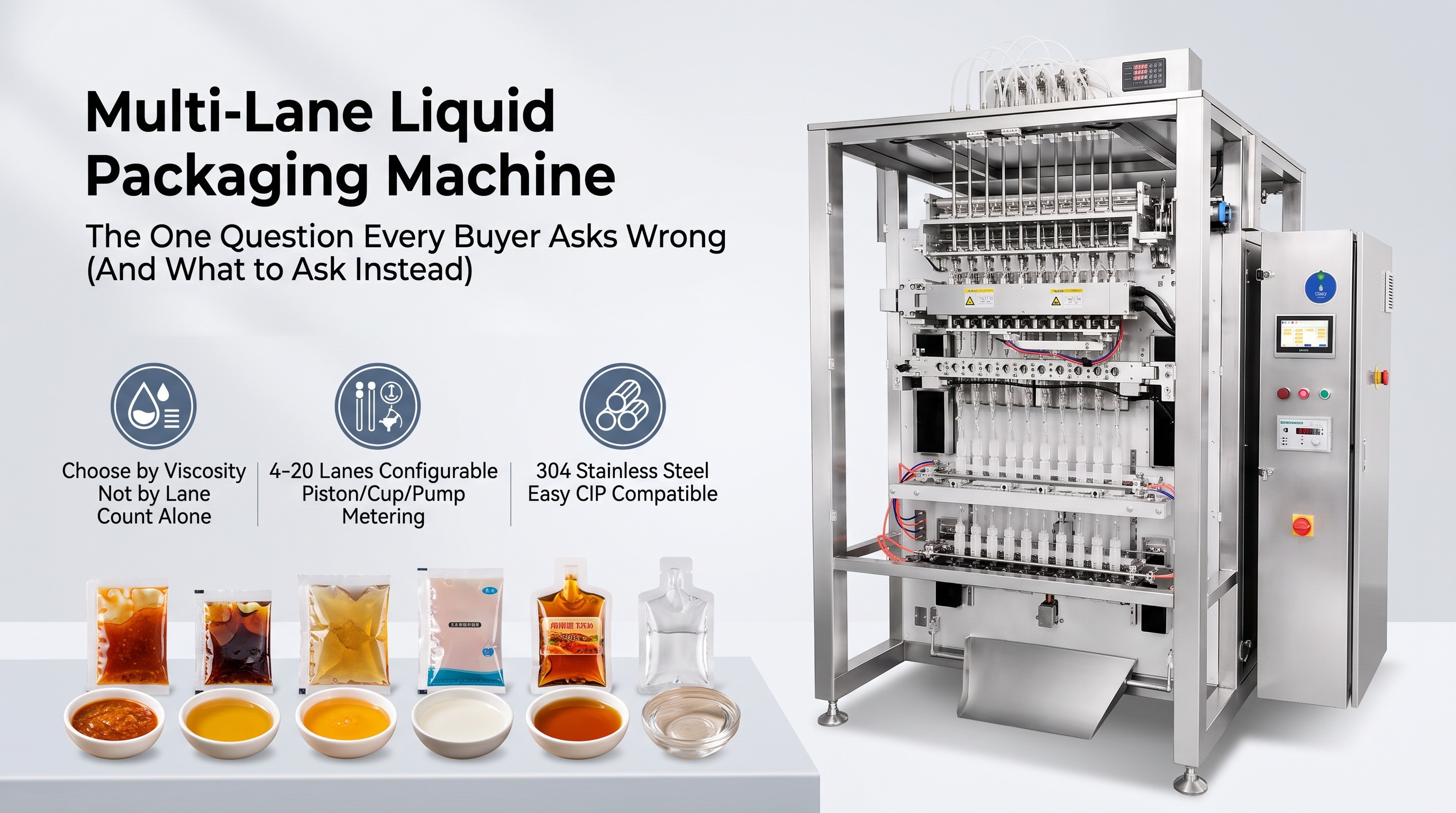
Most people who encounter a multi-lane liquid packaging machine for the first time see something like this:
A stainless steel frame. A roll of packaging film feeding through. Several nozzles dispensing liquid into forming tubes. Sealing jaws closing. A cutter slicing individual packages. And then — bags, bags, bags — rolling off the output conveyor, each one perfectly filled, sealed, and coded.
It looks almost magical. But it's not magic. It's a carefully orchestrated sequence of mechanical, electrical, and software systems working in precise coordination. Understanding how that coordination works isn't just satisfying — it's the difference between choosing the right machine and choosing one that looks good on paper but fails in production.
Let's pull back the curtain.
II. The Five Core Systems
Every multi-lane liquid packaging machine, regardless of brand or lane count, relies on five fundamental systems:
1. Film Feeding and Forming System2. Metering and Filling System3. Sealing and Cutting System4. Control and Sensing System5. Output and Counting System
These systems don't work in isolation. They're synchronized by the machine's central controller — typically a PLC (Programmable Logic Controller) — at speeds that would be impossible for a human operator to coordinate manually.
III. System 1: Film Feeding and Forming
The journey begins with the roll of packaging film mounted on the unwinder. From there, the film travels through a series of guides, tension controllers, and finally the forming collar — the piece that shapes flat film into a tube.
The critical detail most buyers miss: The film tension must be precisely controlled. Too loose, and the print registration drifts — meaning your barcode won't align with the cut point. Too tight, and the film stretches, causing bag length variation.
In ZSYAN's multi-lane machines, each lane has its own independent tension control, managed by a servo motor. This means all lanes maintain consistent film tension even when running at different speeds — something cheaper machines can't achieve.
IV. System 2: Metering and Filling
This is where the liquid actually gets measured and deposited into the forming tube. There are three main metering approaches used in the industry:
Cup metering: A rotating drum with precisely machined cups meters the liquid volume. Best for low-to-medium viscosity fluids (water, light syrups, vinegars). Simple design, easy to clean, but less accurate with viscous products.
Piston metering: A reciprocating piston draws and dispenses a fixed volume of product. Best for medium viscosity (honey, sauces, cream). More accurate than cup metering and handles a wider viscosity range. The most common choice for food and beverage applications.
Pump metering: A positive displacement pump (gear, screw, or peristaltic) pushes product through the nozzle. Best for high viscosity (thick creams, pastes, cosmetic products). Most accurate but most complex and expensive to maintain.
On the SY-LNL series, the standard configuration uses piston metering with an interchangeable cup option. This means the same machine can handle everything from thin oral rinses to thick cream sauces — simply by swapping the metering module. No need to buy different machines for different products.
V. System 3: Sealing and Cutting
Once the liquid is dispensed into the film tube, the sealing and cutting system takes over. This system has two jobs: seal the package closed, and cut it to the correct length.
Three-sided sealing creates a pouch open on three sides (the fourth side is the film's natural seam). It's the most common method for stand-up pouches and produces a clean, professional look. The sealing jaws apply heat and pressure for a precisely timed duration — typically 0.5 to 2 seconds depending on the film material.
Back sealing creates a simple pillow-style pouch by sealing the back seam and then cross-sealing at regular intervals. It's faster and uses less film, making it the most economical option for high-volume food service and industrial packaging.
Four-sided sealing wraps the product in film on all four sides, like a chocolate bar wrapper. It provides the best barrier protection and premium appearance but requires more film and operates at slightly lower speeds.
The cutting system uses either a rotary blade (for continuous cutting during production) or a reciprocating blade (for cutting at rest). Rotary cutting is faster and preferred for high-speed applications above 40 bags/min.
VI. System 4: Control and Sensing
The brain of the machine. Modern multi-lane liquid packaging machines use a PLC combined with a 7-inch color touchscreen HMI (Human-Machine Interface). Here's what that actually enables:
99 programmable recipes: Store the complete settings for each product — bag length, fill volume, sealing temperature, print position — and recall them instantly. Switch from honey to hot sauce in 3 minutes instead of 30.
Real-time fault monitoring: Sensors detect film breaks, empty product hoppers, seal temperature deviations, and bag formation issues. When a fault occurs, the machine stops and displays the exact problem on the screen — often with a diagnostic suggestion.
Multi-language support: The HMI can switch between English, Spanish, French, Arabic, Portuguese, and other languages. Critical for multinational operations where operators speak different languages.
Remote diagnostics: Through a secure internet connection, the manufacturer's technical team can view the machine's status, diagnose faults, and even adjust parameters remotely. This cuts troubleshooting time from days to hours.
VII. System 5: Output and Counting
The final stage. Sealed and cut packages travel along the output conveyor to a counting and bundling station. Some configurations include an automatic bag sorter that arranges packages into rows for manual or automated case packing.
High-end configurations add an automatic palletizer — a robotic arm or stacking conveyor that arranges finished packages onto pallets, ready for shipping. This completes the "machine to pallet" workflow, minimizing manual handling.
VIII. What Makes Multi-Lane Different from Single-Lane
The core technology is the same. The difference is in the synchronization.
A single-lane machine has one set of forming, metering, sealing, and cutting components. A multi-lane machine has multiple identical sets, all operating in parallel and synchronized to the same film feed.
The engineering challenge: Keeping all lanes perfectly synchronized while each lane processes its own product independently. If Lane 3's metering cycle is out of phase with Lane 1, you'll get misaligned seals, uneven bag lengths, or — in the worst case — product waste and jams.
ZSYAN addresses this with a master servo motor that drives all lanes through a shared gear train, with individual lane servos providing fine-tuned adjustment. The result: all lanes move as one, but each can be independently optimized for its specific product.
IX. Three Common Misconceptions About Multi-Lane Machines
Misconception 1: "More lanes always means more output." Not necessarily. A poorly configured 12-lane machine running at 60% efficiency produces less than a well-configured 8-lane machine running at 90%. Lane count is only one factor. Synchronization quality, metering accuracy, and changeover speed matter just as much.
Misconception 2: "All liquid packaging machines handle all liquids." Wrong. A machine optimized for water-thin liquids will struggle with honey. A machine built for thick creams will overfill thin syrups. Always test with your actual products before purchasing.
Misconception 3: "Once it's calibrated, it stays calibrated." Metering systems drift over time due to wear, temperature changes, and product variations. Regular calibration checks — ideally weekly for high-volume operations — keep precision at its best. Machines with self-diagnostic capabilities, like the SY-LNL series, make this easier by alerting you when calibration is needed.
X. The Future: What's Next for Multi-Lane Liquid Packaging?
The industry is moving in three directions:
AI-driven predictive maintenance — Sensors that detect wear patterns before failures occur, scheduling maintenance before downtime happens.
IoT-connected production monitoring — Real-time production data accessible from any device, enabling remote factory management.
Sustainable packaging integration — Machines designed to handle recyclable and compostable film materials without compromising speed or seal quality.
ZSYAN is actively developing all three capabilities in their next-generation multi-lane liquid packaging machines.
XI. Bottom Line
A multi-lane liquid packaging machine is a complex system — but understanding how it works demystifies the purchasing decision. When you know what matters (synchronization quality, metering type, service support) versus what's just marketing (lane count alone, top speed ratings), you can make a choice that's right for your actual production needs.
Have technical questions about multi-lane liquid packaging? Our engineering team is available for free consultations. Send us your product details and we'll explain exactly how the technology applies to your specific materials. Contact us at www.shuangyanpack.com/en/.


