
The Secret Behind Doubling Daily Output Hides in a Double-Lane Granule Packaging Machine
The Secret Behind Doubling Daily Output Hides in a Double-Lane Granule Packaging Machine
I. The Peak Season Headache: Manual Labor Can Never Keep Up
Chengdu, Sichuan — Li, the owner of a seasoning processing factory focused on export, faced a classic dilemma.
Their products are small packages of salt, white sugar, chicken essence, and pepper grains, mainly exported to Southeast Asia and the Middle East. Every year from post-Spring Festival to Mid-Autumn Festival, orders spike to 2-3 times the normal volume.
"We could only accept a portion of orders during peak season," Li recalled. "Because we didn't have enough hands. Hiring temporary workers was costly — training took too long, and packaging quality was inconsistent. Some bags were overfilled, some underfilled. Customer complaint rates soared."
Worse still, they were using a single-lane granule packaging machine with a speed of only 30-40 bags/min, capping daily output at 2,000 bags. During peak season, even running the machine 24 hours a day couldn't meet demand.
The capacity bottleneck was quietly eating into their profits and clients.
II. The Turning Point: A Factory Visit That Changed Everything
Last autumn, Li attended a food processing exhibition and took the opportunity to visit a fellow Sichuan-based factory's packaging workshop.
"I was stunned," Li said. "Same-scale factory, but their daily output was one and a half times ours, with only one operator on the packaging line."
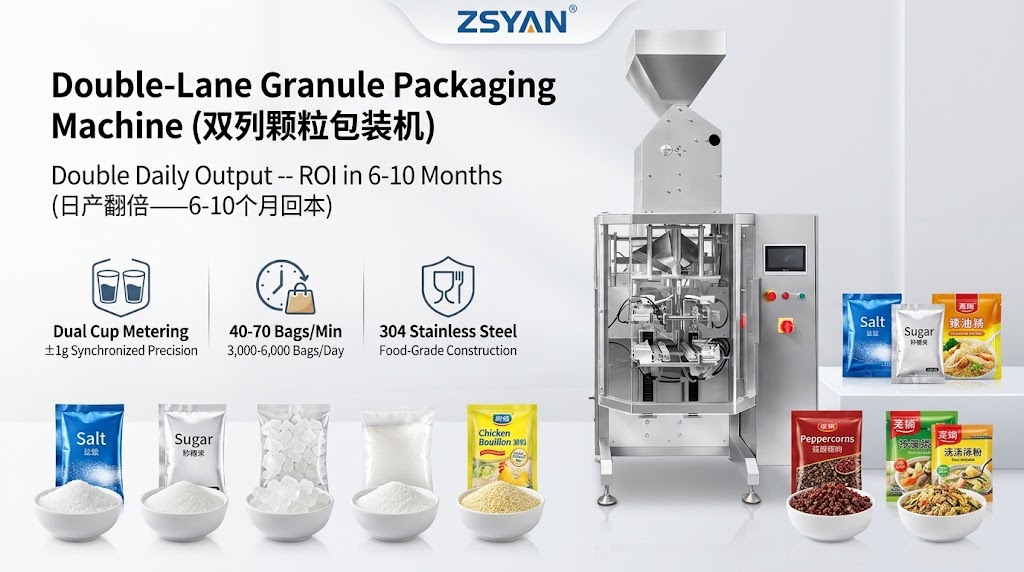
That machine was a double-lane granule packaging machine — two independent cup metering systems working in parallel, each lane running at 35-50 bags/min, for a combined 70-100 bags/min.
"I always thought I needed a multi-lane machine to double capacity," Li said. "I didn't realize a double-lane machine was the most cost-effective expansion solution."
III. The Decision: Why Double-Lane Instead of Multi-Lane?
Back at the factory, Li carefully compared several options:
| Option | Equipment Investment | Daily Capacity | Operators | Payback Period |
|---|---|---|---|---|
| Continue with manual | ¥0 | 2,000 bags | 4 people | — |
| Buy 2 single-lane machines | ¥110,000 | 4,000 bags | 2 people | ~8 months |
| Buy 1 SY-G2L240DL double-lane | ¥85,000 | 5,000 bags | 1 person | ~6 months |
| Buy multi-lane (4-lane) | ¥280,000 | 12,000 bags | 2 people | ~14 months |
Key Insight: The double-lane machine achieves capacity close to a multi-lane at less than one-third the cost, with smaller footprint and simpler operation.
Li ultimately chose the SY-G2L240DL double-lane granule packaging machine, configured with: dual-cup metering + pre-fed vibrating hopper + automatic palletizing conveyor.
IV. Execution: From Installation to Mass Production in 14 Days
The equipment shipped in early September and arrived in Chengdu on September 12. ZSYAN's technical team guided installation and commissioning via video call.
Day one trial run — testing materials: salt, white sugar, pepper grains, Sichuan peppercorns.
"The dual-cup metering system ran smoothly with both lanes operating simultaneously. ±1g precision was achieved on both lanes." — Engineer Zhang, remote diagnostics report
Day two formal production. Li watched the neatly stacked seasoning pouches coming off the line and said, "Faster than I expected."
By day three, daily capacity had risen from 2,000 to 5,000 bags. Staff reduced from 2 to 1.
V. Results: Capacity Doubled, Costs Halved
| Metric | Before (Single-Lane) | After (SY-G2L240DL Double-Lane) |
|---|---|---|
| Daily Capacity | 2,000 bags | 5,000 bags |
| Packaging Speed | 30-40 bags/min | 40-70 bags/min (dual-lane) |
| Operators | 2 people | 1 person |
| Precision | ±1g (single-lane) | ±1g (dual-lane sync) |
| Annual Labor Cost | ¥120,000 | ¥60,000 |
| Annual Savings | — | ¥60,000 |
| Payback Period | — | ~6 months |
More importantly, the hidden benefits:
Peak season order capacity increased by 150%
Customer complaints dropped from 8/month to 1/month
Li freed up time to expand into e-commerce channels
Southeast Asian new customer orders grew 40% by year-end
VI. Li's Recommendation
"If you're a small-to-medium seasoning factory struggling with capacity bottlenecks," Li said, "don't rush to buy a multi-lane machine. First calculate your actual daily capacity needs — if you're in the 3,000-6,000 bags/day range, a double-lane machine is likely your best value choice."
"One machine solves two problems: capacity and labor. That's true cost-effectiveness."


