
Before Buying a Double-Lane Granule Packaging Machine, Calculate This Cost First
Before Buying a Double-Lane Granule Packaging Machine, Calculate This Cost First
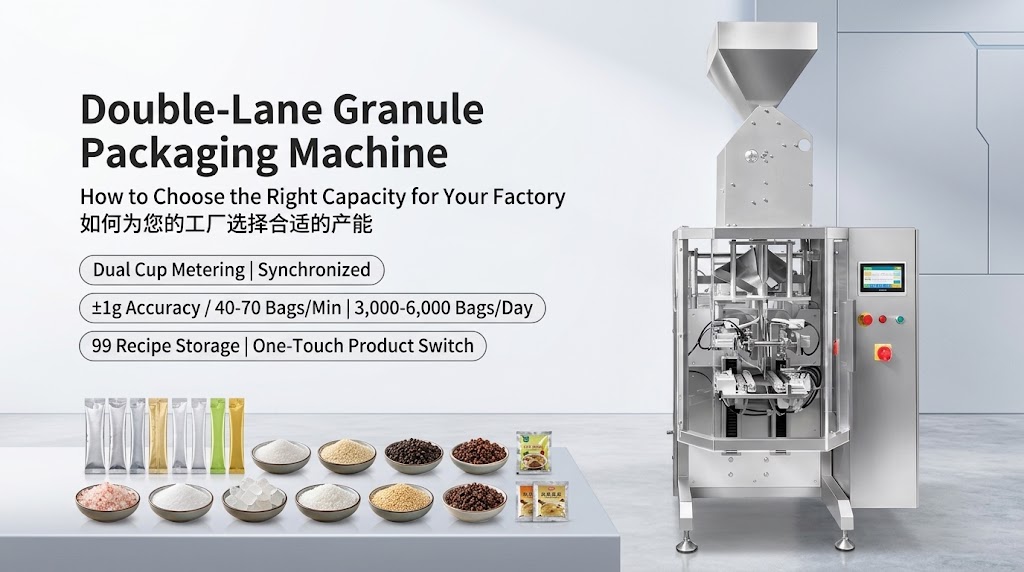
I. The Number on the Quote Is Only the Tip of the Iceberg
Search "double-lane granule packaging machine" on any e-commerce platform, and you'll see prices ranging from ¥60,000 to ¥150,000.
What drives the difference? Different configurations, different accessories, different brands — those are the visible reasons.
But the more critical question is: many buyers only look at the equipment quote and forget to calculate what the machine truly costs after it arrives at their factory.
Equipment price accounts for only about 30% of the three-year total cost of ownership. The remaining 70% is spread across labor, energy, maintenance, consumables, and hidden waste. Choose the wrong model or configuration, and you'll be paying for that mistake for five years.
II. First Bill: Labor — The Largest Hidden Cost
Many factory owners calculate equipment depreciation but forget about labor.
In reality, labor cost often exceeds the equipment itself.
Take a SY-G2L240DL double-lane granule packaging machine as an example:
Equipment investment: ¥85,000
Operators needed: 1 (can share with existing staff)
Workers replaced: 2-3
Annual labor savings: ¥6,000-¥12,000
But here's a trap: if your production line had 3 packers before, switching to a machine does not make those 3 people disappear. You need to decide — do they transfer to other roles, get laid off, or do you still need to hire because the machine isn't enough?
Correct calculation: look at "net replaced workers," not "how many workers the machine saves."
III. Second Bill: Energy — Cheap Electricity Is Still Money
Many people ignore energy costs, thinking "how much electricity can one machine use?"
Let us calculate:
| Item | SY-G2L240DL Double-Lane |
|---|---|
| Rated Power | 3.5KW |
| Daily Operation | 10 hours |
| Annual Consumption | 12,750 kWh |
| Annual Electricity Cost (¥0.8/kWh) | ¥10,200 |
| Cost Per Bag | ¥0.002 |
Selection advice: do not chase the highest speed model. If your daily demand is 4,000 bags, a SY-G2L240DL double-lane is sufficient. Upgrading to a multi-lane machine costs an extra ¥150,000 in equipment plus ¥5,000/year in electricity — it may take five years to recover that difference through speed alone.
IV. Third Bill: Maintenance — Do Not Just Look at the Warranty Period
Equipment quotes usually include a one-year warranty. But what happens after?
| Maintenance Item | Annual Cost Estimate | Notes |
|---|---|---|
| Wear parts replacement (sealing strips, cutters, etc.) | ¥2,000-¥3,500 | Replace every 6-12 months |
| Lubrication service | ¥800 | Can be done in-house |
| Sensor calibration | ¥1,500 | Recommended annual professional calibration |
| Breakdown repair (average) | ¥3,000-¥6,000 | Depends on brand and material |
| Annual Maintenance Total | ¥7,300-¥14,800 | — |
Key insight: brand differences show most in maintenance cost and failure rate. Low-price machines typically have 2-3x the failure rate of branded machines, meaning an extra ¥3,000-¥6,000/year in repairs, plus downtime losses.
V. Fourth Bill: Hidden Waste — Precision Is Profit
This is the most overlooked, yet most impactful cost.
Manual or low-end machines with ±3g error mean each bag averages 1.5g extra. At 25g/bag:
Annual output: 4,000 bags/day × 300 days = 1,200,000 bags
Average overfill: 1.5g/bag
Annual extra waste: 1,800 kg
At ¥8/kg product price, hidden waste value: ¥14,400/year
Switching to dual-cup metering at ±1g precision:
Average overfill: 0.5g/bag
Annual extra waste: 600 kg
Hidden waste value: ¥4,800/year
Annual savings: ¥9,600
Over five years, precision improvement alone saves nearly ¥48,000 — far exceeding any equipment price difference.
VI. Suitable Materials for Double-Lane Granule Packaging Machines
Seasoning Category:
Salt, white sugar, rock sugar
MSG, chicken essence
Pepper grains, Sichuan peppercorns
Dry soup packs
Unsuitable Materials:
Large块物料 (>20mm, e.g., whole garlic)
Sticky物料 (e.g., peanut butter)
Liquid or paste materials
Ultra-fine powders (should select powder packaging machine)
VII. Total Cost of Ownership Formula
3-Year TCO = Equipment Investment + 3-Year Labor Cost (Before vs. After) + 3-Year Energy Cost + 3-Year Maintenance Cost + 3-Year Hidden Waste Cost - Resale ValueDo not just look at the equipment quote — run this formula. The answer may surprise you.
VIII. Selection Decision Checklist
Before contacting suppliers, prepare the following information:
Your Real Capacity Demand:
Current daily output: ___ bags
Estimated demand in next 12 months: ___ bags
Peak period demand: ___ bags (used to confirm model size)
Your Material Properties:
Particle size range: ___ mm
Flowability: Free-flowing / Prone to caking / Prone to dust
Corrosiveness: Food-grade / Lightly corrosive / Strongly corrosive
Your Current Hidden Costs:
Current packaging labor cost: $___/month
Current precision error waste: $___/month
Current hiring/training cost: $___/year
Your Decision Timeline:
Expected payback period: < 12 months / 12-18 months / 18+ months
IX. Common Selection Traps
Trap 1: "Bigger is better" Buying an oversized machine means it runs at low load most of the time, wasting energy and depreciation.
Trap 2: Only looking at equipment price, not TCO Low-price machines have higher failure rates and poorer precision, costing more over three years.
Trap 3: Ignoring compatibility The machine you buy does not support your existing film or bag type, requiring costly retrofits.
Trap 4: Not considering scalability It is enough now, but in a year capacity will not be enough, and you will need to buy again.
X. Action Recommendations
Calculate first, then inquire — Use the TCO formula above to estimate your real cost
Send samples for trial runs — Different materials perform differently on different machines
Request a 3-year TCO report — Ask suppliers for a complete cost analysis
Confirm after-sales terms — Warranty scope, spare parts supply, response time
Buying a double-lane granule packaging machine is not a one-time purchase — it is a three-year decision. Calculate carefully, and you will choose the right machine.
Not sure which model to pick? Visit shuangyanpack.com for a free TCO assessment and selection advice.


