
3x Daily Output — How an 8-Lane Granule Packaging Machine Transformed a Seasoning Exporter
3x Daily Output — How an 8-Lane Granule Packaging Machine Transformed a Seasoning Exporter
I. The Peak Season Dilemma: 4-Lane Machine Running at Full Capacity
Foshan, Guangdong, a food processing factory specializing in seasoning exports, faced a typical challenge.
Their products include small-packaged salt, white sugar, chicken essence, and pepper grains, mainly exported to Southeast Asia and the Middle East. From before Chinese New Year to Mid-Autumn Festival, the peak season sees order volumes 2-3 times normal levels.
"We could only accept partial orders during peak season," Mr. Chen recalled. "With our 4-lane granule packaging machine, daily capacity was limited to 5,000 bags, but customers were placing orders of 8,000 bags minimum. We simply couldn't keep up."
What made things worse was the labor cost. The 4-lane machine required 3 operators working in shifts, with high labor costs mounting up. And during peak seasons when worker turnover was high, the machine would sit idle waiting for staff.
The capacity bottleneck was quietly eating into their profits and customer relationships.
II. The Turning Point: A Visit to a Peer's Factory
Last autumn, Mr. Chen visited a food processing exhibition and took the opportunity to tour a peer's packaging workshop.
"I was stunned," Mr. Chen said. "A factory of similar size had 3x our daily output, but their packaging line only needed 1 operator."
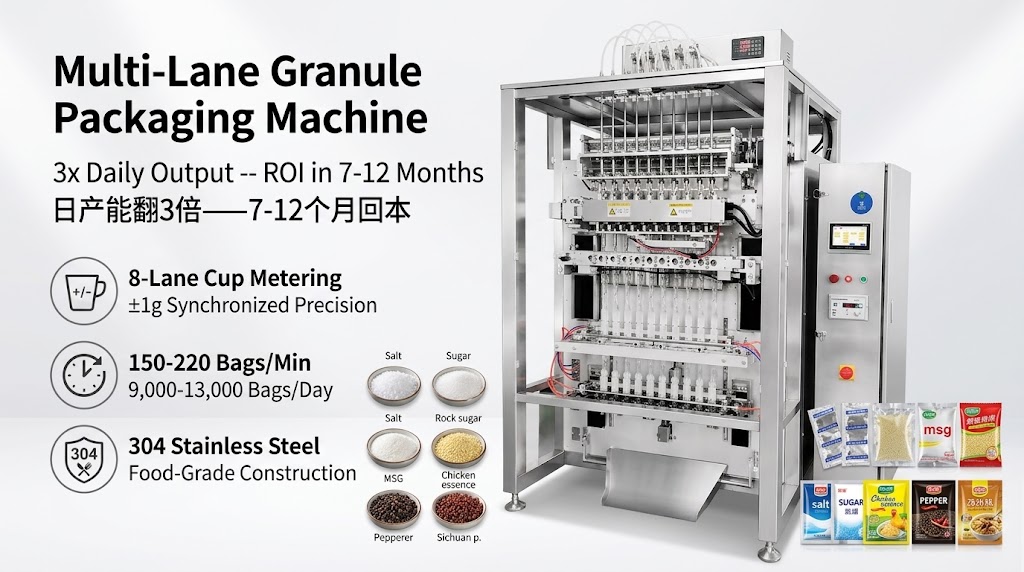
The machine was a multi-lane granule packaging machine — eight independent cup metering systems working in parallel, each lane at 20-30 bags per minute, totaling 160-240 bags per minute.
"I used to think I needed a multi-lane machine to double capacity," Mr. Chen said. "Now I understand, multi-lane is the optimal solution for high-volume production."
III. The Decision: Why Choose 8-Lane Instead of 4-Lane?
Back at the company, Mr. Chen carefully compared several options:
| Option | Equipment Investment | Daily Output | Operators | Payback Period |
|---|---|---|---|---|
| Continue with 4-lane | ¥0 | 5,000 bags | 3 people | — |
| Buy 2x 4-lane machines | ¥180,000 | 10,000 bags | 4 people | ~10 months |
| Buy 1x SY-ML800DL 8-lane | ¥165,000 | 18,000 bags | 1 person | ~7 months |
| Buy 4-lane + 6-lane combo | ¥280,000 | 15,000 bags | 3 people | ~12 months |
Key Finding: More lanes doesn't always mean better. Choosing the right model for your exact capacity needs saves money.
Mr. Chen's daily demand was 12,000-15,000 bags. One SY-ML800DL 8-lane machine running at 150-220 bags per minute could handle this within a 10-hour shift. No need for 2x 4-lane machines or complex combinations — getting the right model was more cost-effective.
IV. Execution: From Selection to Production in 30 Days
Mr. Chen sent samples to ZSYAN: salt, white sugar, chicken essence, and pepper grains.
Three days later, the technical team sent test results:
Cup metering system fully compatible with your materials. Recommended configuration: SY-ML800DL 8-lane model x 1 + large-capacity vibrating hopper + automated palletizing conveyor. Expected daily output increase from 5,000 bags to 18,000 bags, accuracy ±1g, operators reduced from 3 to 1.
Equipment shipped in early August, arrived in Foshan within 10 days. ZSYAN technical team provided remote installation guidance and commissioning, trial run completed within the second day.
On the first day of full production, watching eight lanes simultaneously output packaged salt, Mr. Chen said: "I wish I had bought this three years ago."
V. Results: Three Measurable Changes in One Quarter
| Metric | Before Upgrade | After Upgrade | Change |
|---|---|---|---|
| Daily Output | 5,000 bags | 18,000 bags | +260% |
| Operators | 3 people | 1 person | Saved 2 people |
| Monthly Savings | — | ~¥15,000 | — |
| Payback Period | — | 7 months | — |
What surprised Mr. Chen most was the accuracy performance. "Previously with the 4-lane machine, accuracy would fluctuate when switching products. Now with 8-lane synchronized metering, ±1g accuracy stays consistent from morning to night."
VI. Advice for Peers
Mr. Chen shared three pieces of advice:
Calculate your daily demand first, then choose lane count — Don't blindly pursue high lane counts. Choosing the right capacity is most cost-effective.
Insist on sample testing — Different materials have different flow properties. Only real testing can determine the best configuration.
Choose a brand with global service capability — Multi-lane machines are complex. Remote diagnosis and parts supply capabilities are crucial.
"If your daily capacity requirement exceeds 8,000 bags, a multi-lane granule packaging machine is not optional — it's essential."


