
Stop Being Fooled by Spec Sheets: A 72-Hour Vertical Mesh Bag Packaging Machine Review
Stop Being Fooled by Spec Sheets: A 72-Hour Vertical Mesh Bag Packaging Machine Review
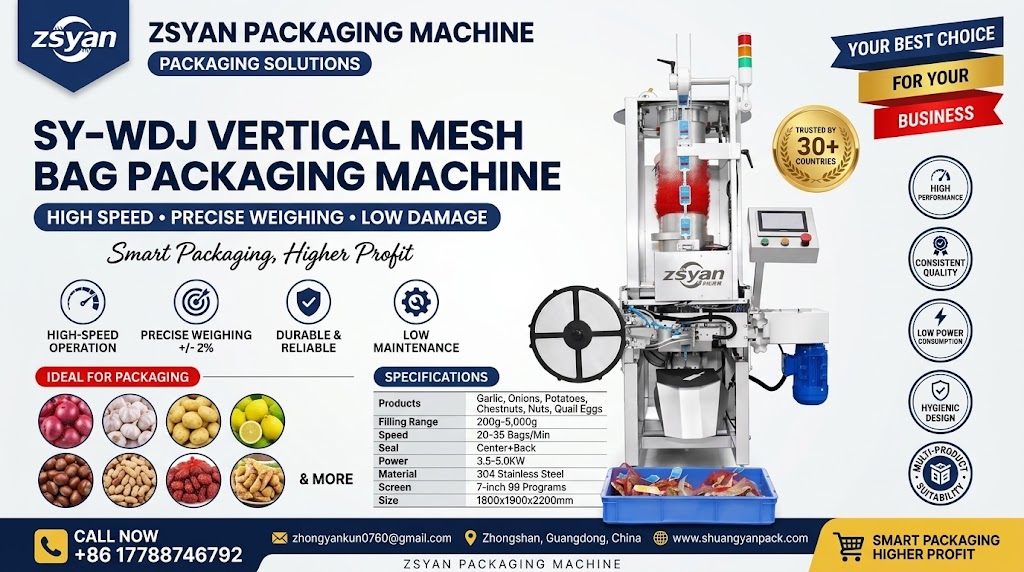
Buyers of vertical mesh bag packaging machines usually get stuck on the same dilemma. Imported premium brands publish impressive spec sheets, but they come with high prices, long lead times, and expensive after-sales service. Low-cost domestic machines are cheap, but their parameters are often inflated and reliability is a gamble. Ask ten peers and you will hear ten opinions. Who do you trust?
A spec sheet will not answer that question. A 72-hour continuous test will.
The Method: One Simulated Line, Five Machines, Seventy-Two Hours
To make this review fair, we built a simulated production line and ran a continuous 72-hour stress test on five vertical mesh bag packaging machines using three typical products: onions, garlic, and chestnuts. The lineup included International Brand A (European import), International Brand B (Japanese), Domestic Brand X, Domestic Brand Y, and the ZSYAN vertical mesh bag packaging machine SY-WDJ5000A (200 g–5 kg).
Every machine used the same batch of material and a uniform 500 g bag weight standard. Actual throughput, failure count, and bag length deviation were recorded hourly. The evaluation covered four dimensions: measured efficiency, customization capability, running stability, and global service.
Round 1: Measured Efficiency — Stated Speed vs. Real Output
Stated speed is the easiest number to beautify. In our test, International Brand A claimed 35 bags/min but stabilized at 30 bags/min. Domestic Brand Y claimed 40 bags/min but delivered only 26 bags/min — the gap came from feeding adaptation and anti-jam design. The ZSYAN vertical SY-WDJ5000A is rated at 20–35 bags/min; on onions it stabilized at 33 bags/min, and after switching to chestnuts with one of 99 stored recipes, it kept 31 bags/min.
The lesson: treat stated speed as a reference, never as a promise. Real output on a vertical machine can only be verified by running your own material.
Round 2: Customization — Does the Machine Recognize Your Material?
A vertical mesh bag machine has mature construction, but its worst enemy is the "one-size-fits-all" approach: irregular products jam in the feeding channel, and soft fruit gets bruised when it drops into the bag. International Brand B faced dusty garlic and uneven chestnuts and simply recommended "switch to standard material." Domestic Brand X does not even offer a basic vibratory feeding option.
ZSYAN vertical machines can be customized with vibratory feeding and buffered filling matched to your product, with pre-delivery trials using your own material. Customization is not an add-on accessory — it is a feeding system engineered around your product.
Round 3: Stability — Who Fails First in 72 Hours?
The stress test got cruelest in the third round. Domestic Brand X suffered a net-tear failure at hour 41 and stopped for 45 minutes. Domestic Brand Y developed bag-length drift at hour 63, and the reject rate jumped to 9%. International Brand A ran stable throughout but depends on proprietary mesh bag film, which pushes up long-term consumable costs.
The ZSYAN vertical machine completed all 72 hours with zero unplanned downtime and kept the reject rate below 1.2%. Net changes take about two minutes, and manual net replacement does not interrupt production. Behind that stability are servo-motor and variable-frequency drive tension control, plus anti-damage and anti-tangle design on a food-grade 304 stainless steel frame.
What We Did Not Measure — But You Should
One thing a 72-hour test cannot capture is the fifth dimension: operator experience. A machine that requires an engineer for every changeover will burn your best operators out. The 7-inch touchscreen and 99 recipes on the ZSYAN units meant changeover was handled by the line operator without waiting for technical support — a quiet advantage that showed up in every shift report.
Round 4: Global Service — Machines Can Be Far Away; Service Cannot
A machine's useful life is far longer than the moment of purchase. International Brand A quotes 7–10 days for an engineer visit, billed by the hour. Domestic Brand Y's support is mostly phone guidance, which makes remote faults hard to locate.
ZSYAN provides remote diagnostics with 24-hour response, multi-language interfaces (English, Arabic, Spanish), and installation experience across 30+ countries. For an export-oriented company, the service network is the insurance policy for the production line.
Conclusion: Choosing Equipment Is Choosing a Long-Term Partner
One more number deserves attention: total cost per 1,000 good bags. It combines purchase price, consumables, waste, downtime, and service. Across all five machines, the most expensive machine was not the one with the highest price tag — it was the one that lost production to downtime and rejects. That is the number a spec sheet never shows you.
After four rounds, the conclusion is clear: spec sheets can be polished and prices can be squeezed, but efficiency, customization, stability, and service decide whether a vertical mesh bag packaging machine makes you money or makes you worry.
Action
Free trial slots are limited. Visit shuangyanpack.com, bring your material, and book a free solution consultation and live test.
ZSYAN — Your Trusted Partner in Smart Packaging.


