
Vertical Mesh Bag Packaging Machine Selection Guide: How to Choose in 3 Steps and Avoid 90% of the Pitfalls
Vertical Mesh Bag Packaging Machine Selection Guide: How to Choose in 3 Steps and Avoid 90% of the Pitfalls
When the garlic harvest arrives and onion export season begins, many factory owners start asking the same question: should we automate? But asking "which machine is best" at that moment is already too late — in peak season, machines have lead times and labor costs rise. You end up paying on both ends.
Choosing a vertical mesh bag packaging machine is rarely about reading parameters. The hard part is understanding your own requirements first.
Think of It as the "Smart Joint" of Your Line
If your packaging line is a body, the vertical mesh bag machine is its smart joint: it replaces workers in the most repetitive tasks — filling, labeling, and tying bags — and decides whether the whole line runs smoothly. A vertical model is compact and space-efficient, which makes it the natural first step for most produce and nut lines. Choose the wrong joint and the whole body suffers. Choose the right one, and even peak season stays calm.
Self-Diagnosis: Which Decision-Maker Are You?
| Role | Top concern | Core decision factor |
|---|---|---|
| Factory owner | How long until the machine pays back? | Return on investment |
| Production manager | Can the line survive peak season? | Efficiency and stability |
| Purchasing manager | Is pricing transparent? Hidden after-sales costs? | Price + quality + service |
If you fit any of these roles, run your selection through the three dimensions below.
Three Filtering Dimensions
Dimension 1: Customization — The Machine Must Recognize Your Material
Dusty onions, uneven chestnuts, brittle red dates — generic machines jam on these products and bruise soft fruit when it drops. There is really one test: will the supplier trial your own material, and can they provide custom designs such as vibratory feeding and buffered filling?
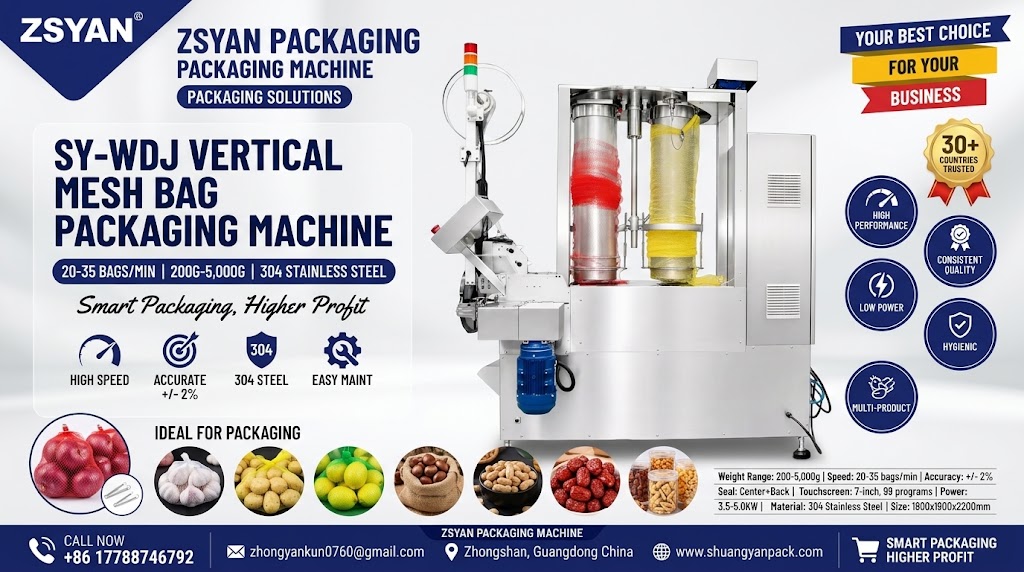
ZSYAN vertical machines insist on "trial first, deliver second." They cover bag sizes from 200 g to 5 kg and optimize anti-damage and anti-tangle design for irregular products. What a generic machine cannot offer is exactly where line stability begins.
Dimension 2: Stability — Measure Output in Days, Not in Hours
Stated speed is only a reference; continuous operation is the truth. Ask whether the drive is servo-based or mechanical, whether anti-jam and anti-tangle designs exist, and whether net changes stop production.
ZSYAN vertical machines use servo motors plus variable-frequency drives for a stable 20–35 bags/min, 99 recipes for one-touch product switching, net changes in about two minutes, and manual net replacement without stopping the line. In practice, reject rates can be held below 1.2%. Output should be planned by the day, not gambled by the hour.
Dimension 3: Global Fit — Export Equipment Must Understand Export Business
If you sell abroad, the machine must satisfy three things: voltage compatibility (AC220V/50Hz/60Hz), a multi-language interface, and after-sales support that can respond remotely.
ZSYAN interfaces support English, Arabic, and Spanish; we provide remote diagnostics with 24-hour response; the machines carry CE certification and ISO 9001; and we have export experience across 30+ countries. For an exporter, choosing ZSYAN is like buying an insurance policy for the production line.
Why the Payback Math Works in Your Favor
It helps to put the dimensions into numbers. A line packing mesh bags by hand typically needs 6–10 workers per shift in peak season. At 20–35 bags/min, one vertical machine replaces the work of several operators while running a full shift, and 99 stored recipes mean changeover downtime is measured in seconds rather than hours. In illustrative scenarios, customers have reported annual labor savings in the six figures while cutting damage-related waste by more than half. The machine pays for itself through what it removes: overtime, rework, and rejected export batches.
Comparison at a Glance
| Dimension | ZSYAN Vertical | International Brand A | Domestic Brand X |
|---|---|---|---|
| Pricing transparency | Factory-direct, no middleman | Clear channel markups | Low price, parts charged separately |
| Customization | Trial first, solution-based | Mostly standard models | Almost none |
| Stability | Servo + VFD, reject rate <1.2% | Stable but proprietary film | Inflated specs, lower real output |
| Global service | 30+ countries, 24-hour response | 7–10 day response | Phone guidance only |
Two Common Mistakes
Mistake 1: "More expensive means more stable." Price and stability are not the same thing. Real stability comes from the drive system and anti-damage design, not brand premium.
Mistake 2: "Buy cheap first, replace later." The hidden cost of switching — downtime, waste, missed delivery dates — usually exceeds the price difference. One wrong choice can cost you years.
A Three-Step Action Checklist
Define your material. Bag weight range (200 g–5 kg), product shape, fragility, and your product plan for the next three years.
Calculate capacity. Set the target output per hour, then work backwards to speed, shifts, and changeover frequency.
Confirm service. Verify remote diagnostics, multi-language interface, trial verification, and spare parts availability.
Take Action
Visit shuangyanpack.com, submit your sample, and receive a free solution and trial scheduling.
ZSYAN — Your Trusted Partner in Smart Packaging.


