
180K RMB Annual Labor Cost Replaced by One Machine — How a Chinese Snack Factory Bought Back Its Profit
180K RMB Annual Labor Cost Replaced by One Machine — How a Chinese Snack Factory Bought Back Its Profit
I. Crunch the Numbers: How Expensive Is Manual Packaging Really?
Suzhou, Jiangsu Province. A snack food factory specializing in roasted nuts, run by Mr. Zhang. The factory has 3 production lines, each staffed with 2 packers who fill aluminum foil bags with cashews, macadamia nuts, and mixed nuts, then heat-seal, code, and box them.
During peak season, Mr. Zhang did the math:
Two workers per line, three lines — that's 6 people. Including overtime, year-end bonuses, and social insurance, each person costs about $4,500/year. Six people, that's 180,000 RMB annually. That's not a small number.
But what worried Mr. Zhang more than the cost was the turnover. Every year around Chinese New Year, workers leave in droves. When he couldn't find replacements, machines sat idle for days. Orders piled up, customers complained, and the reputation he'd spent years building started to erode.
Machines waiting for people is more painful than people waiting for machines.
II. The Turning Point: A Remark from a Fellow Exhibitor
Last mid-year, Mr. Zhang attended a trade show and ran into a peer in the same industry. The other factory had already gone fully automated, with three times the daily output and only a third of the workforce.
"You're still packing by hand?" the peer asked.
"No choice," Mr. Zhang replied. "Volume's too small, a machine wouldn't pay for itself."
"Have you calculated it?" the peer countered. "One machine saves 180,000 RMB a year on labor. It pays for itself in three years. After that, it's pure profit."
That sentence sent Mr. Zhang home to recalculate everything.
III. The Calculation: What Does 180K RMB Buy You?
Mr. Zhang contacted several packaging machine manufacturers and compared proposals:
| Option | Equipment Investment | Annual Labor Savings | Annual Maintenance/Energy | Annual Net Benefit | Payback Period |
|---|---|---|---|---|---|
| Continue manual | ¥0 | ¥0 | ¥15,000 | -¥165,000 | — |
| Buy 2× SY-G2L180 | ¥105,000 | ¥84,000 | ¥25,000 | -¥4,000 | ~6 years |
| Buy 3× SY-G2L180 | ¥157,500 | ¥126,000 | ¥37,500 | -¥6,000 | ~7 years |
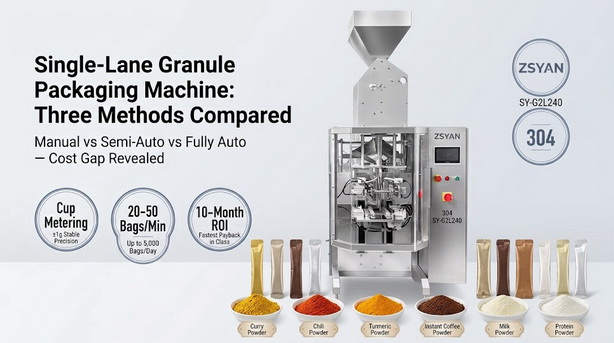
| Buy 1× SY-G2L240 | ¥63,000 | ¥84,000 | ¥22,000 | +¥71,000 | ~10 months |
Key insight: More machines doesn't mean better results. The right model at the right capacity is what matters.
Mr. Zhang's daily demand was 2,500-3,000 bags. One SY-G2L240 running at 35-50 bags/min for 10 hours easily covers that. No need for three single-lane machines, no need for a multi-lane system — just one properly sized machine.
IV. Execution: From Selection to Launch in 30 Days
Mr. Zhang sent samples to ZSYAN: cashews, macadamia nuts, and mixed nuts (including almonds and walnut kernels).
Three days later, the technical team sent back the test results:
Cup metering system is compatible with your materials. Recommended configuration: SY-G2L240 back-seal x 1 unit + front vibrating hopper + auto palletizing conveyor. Expected daily output: 3,000 bags. Labor reduced from 6 to 1. Precision ±1g.
The equipment shipped in early August and arrived in Suzhou within 10 days. ZSYAN's technical team provided remote installation guidance, and the trial run was completed within 12 hours.
On the first day of full production, Mr. Zhang watched neat little packets of nuts stream down the line and said: "I should have done this three years ago."
V. Results: 180K RMB Turned Into Profit
| Metric | Before (Manual) | After (SY-G2L240) |
|---|---|---|
| Daily capacity | 800 bags | 3,000 bags |
| Operators | 6 workers | 1 worker |
| Precision | ±3g (unstable) | ±1g |
| Annual labor cost | 180,000 RMB | 30,000 RMB |
| Annual savings | — | 150,000 RMB |
| Payback period | — | ~10 months |
The invisible benefits were just as significant:
On-time delivery rate rose from 72% to 99%
Customer complaints dropped from 5 per month to zero
Mr. Zhang freed himself from production management and started expanding into e-commerce
Using the savings, he opened a second store by year-end
VI. Mr. Zhang's Advice
Don't wait until you can't find workers before thinking about automation. Labor costs rise every year, while machine prices stay relatively fixed. Upgrade one day sooner, and you shift your cost structure from fixed labor to variable energy — a far healthier position.
Calculate before you buy. Don't let "my volume is too small" fool you. Many people think small factories don't need automation, but once you run the numbers, a single properly-sized machine is often cheaper than keeping people on the line.
Choose the right model, not more machines. Mr. Zhang regrets that he almost bought three single-lane machines after asking around — only to discover later that one high-speed model would have been sufficient and cheaper.


